
Miniaturized Multiplex Electrochemical Biosensors
VERI-BIOID MX is a platform for compact electrochemical biosensors designed for multiparametric analysis in point-of-care testing (POCT), personalized medicine and decentralized diagnostics.
The platform combines electrochemical sensor architectures, biochemical recognition elements and electronic readout to enable the measurement of multiple analytes within a compact analytical system.
VERI-BIOID MX builds on RIVALTEC’s adhesiveless Flexible Hybrid Electronics (FHE) technology, which enables the direct additive fabrication of precision conductive structures on flexible polymer substrates. This provides a versatile technological foundation for compact, adaptable and scalable sensor architectures.
Multiplex Analysis for Point-of-Care Diagnostics
Many diagnostic tasks require the assessment of several biomarkers to obtain a more comprehensive picture of a patient’s condition. Multiplex electrochemical biosensors enable multiple analytes to be measured within a single sensor system, supporting integrated diagnostic assessment and patient monitoring.
Depending on the application, sensor arrays can incorporate multiple working electrodes with different biochemical recognition elements, together with reference and control electrodes. Repeated measurement sites can support consistency checks and statistical assessment of analytical results.
This approach is relevant to rapid diagnostics, personalized medicine and decentralized healthcare, where timely access to multiparametric measurements can support clinical decision-making and monitoring of changes in a patient’s condition.
Miniaturized Sensor Architecture
RIVALTEC’s adhesiveless FHE technology enables the formation of precision biocompatible conductive patterns on flexible polymer substrates .
VERI-BIOID MX applies this technological approach to compact multiplex electrochemical sensor architectures, combining electrode arrays, biochemical functionalization and electronic readout.
An illustrative configuration includes:
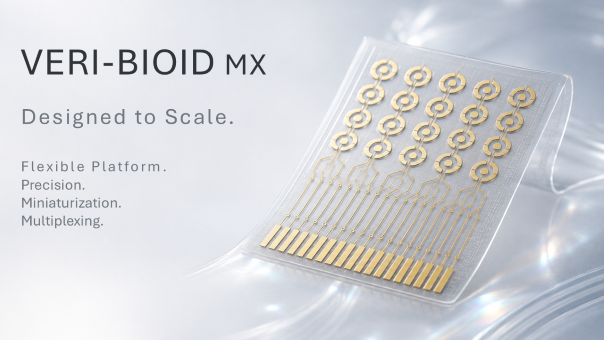
- Electrode array: a 5 × 4 arrangement comprising 20 electrode sites.
- Representative dimensions: approximately 20 × 50 mm for the sensor format, the working area : 20-25 electrodes \ S=1.5 cm x 1 cm .
- Flexible substrate: a polymer film carrying precision conductive structures.
- Multiplex functionality: working electrodes can be functionalized with different biochemical recognition elements to detect selected analytes.
- Reference and control elements: incorporated according to the requirements of the measurement architecture.
- Reader interface: a contact-based connection, such as a contact comb or zero-insertion-force (ZIF) connector, can be used to connect the sensor to an electronic reader.
The 20-site array illustrates one possible implementation of the architecture rather than a fixed product specification. Electrode number, layout, biochemical functionalization and fluid-handling arrangements can be adapted to the intended analytical task.
The objective is to balance the number of measurable analytes, analytical reliability, manufacturing scalability and cost.
Sensor Operation and Sample Handling
A VERI-BIOID MX system can combine a sensor, an electronic reader, the necessary consumables and a data-processing workflow.
Depending on the configuration, a liquid sample can be delivered to the sensing area directly or through microfluidic channels. Capillary-driven filling can provide sample delivery without an external pump in suitable designs.
The sample interacts with biochemical recognition elements associated with selected electrodes. The resulting electrochemical signals are measured by the reader and processed to extract analytical information.
The sensor architecture can incorporate reference electrodes, counter electrodes and control sites as required. Signal-processing methods can include background subtraction, comparison of repeated measurements and normalization to improve the consistency and interpretability of results.
Specific biochemical coatings, sample volumes, fluidic dimensions and analytical performance depend on the selected assay and application.
Biochemical Recognition and Multiparametric Measurement
Electrochemical biosensors combine a transducer with biochemical recognition elements that interact with target substances. Depending on the analytical task, these elements can include antibodies, aptamers, antigens, DNA-based receptors or enzymes.
Different recognition elements can be integrated into a multiplex array to support the measurement of several biomarkers or other target analytes within one system.
The architecture can accommodate application-specific combinations of electrode materials, surface functionalization and sample handling. This flexibility provides a basis for developing sensor configurations tailored to different diagnostic and research requirements.
Manufacturing and Scalability
Adhesiveless FHE structures provide a manufacturing foundation for integrating conductive patterns on flexible polymer substrates. The architecture can be adapted to different sensor layouts and is compatible with scalable manufacturing approaches, including roll-to-roll (R2R) processing where appropriate.
For biosensor applications, feature dimensions and electrode geometry are selected according to the requirements of the biochemical assay, fluid handling and readout system. The objective is not simply to minimize feature size, but to achieve an effective balance between analytical performance, reliability, manufacturability and cost.
Compact multiplex architectures can also help reduce the need for separate sensor formats and support the integration of multiple analytical functions within a single system.
Data Processing and Digital Integration
The VERI-BIOID platform can integrate sensor measurements with digital data-processing and management systems.
A typical data workflow can include acquisition, sample or measurement identification, signal processing, storage and transfer. Depending on the implementation, analytical data can support longitudinal monitoring, research, personalized medicine and clinical or operational decision-making.
Data architecture, access control and information security are important considerations in systems handling sensitive diagnostic and patient-related information.
Applications in Personalized Medicine
Multiplex electrochemical biosensors can support personalized medicine by enabling the assessment of multiple biomarkers and tracking changes in their profiles over time.
Potential application areas include:
- Rapid point-of-care diagnostic testing.
- Multiparametric biomarker assessment.
- Personalized patient monitoring.
- Monitoring changes in biomarker profiles over time.
- Assessment of biological responses to treatment.
- Decentralized clinical studies and research workflows.
The clinical value of each application depends on the biomarkers selected, the validation of the corresponding assays and the context in which the measurements are used.
An Adaptable Platform for Multiplex Sensing
VERI-BIOID MX combines the biocompatible adhesiveless FHE structures with electrochemical sensing and application-specific biochemical recognition. Rather than prescribing a single electrode layout or assay, the platform supports different sensor configurations according to analytical requirements.
By bringing together compact electrode architectures, multiparametric measurement and scalable manufacturing approaches, VERI-BIOID MX provides a technological basis for point-of-care diagnostics and personalized medicine.